Rendivo ExterminatorsRendivo Exterminators

Basement Flea and Tick Eradication Pittsburgh

Older Allegheny County home architecture features structural conditions that actively shelter parasite pupae. Unfinished basements in Lawrenceville row homes, historic stone foundations in Squirrel Hill, and exposed…
Get My Free Estimate →(412) 730-8164
Basement Flea and Tick Eradication in Pittsburgh, PA
Quick answer
  • What is included: Diagnostic sub-grade inspection, HEPA containment vacuuming of floor cracks, micro-encapsulated adulticide application, and insect growth regulator (IGR) barriers.
  • Turnaround speed: Initial inspection and therapeutic knockdown take 90 to 120 minutes per 1,000 square feet of basement floor space.
  • Cost range: Standard residential basements range from $200 to $475 based on unfinished foundation square footage and host harborages.
  • Targeted materials: Subterranean treatments focus on unfinished concrete, stone rubblestone foundations, floor drains, and perimeter sill plates where larvae mature.
  • Scheduling contact: Confirmed on-site quotes and scheduling are available by calling (412) 730-8164.

Older Allegheny County home architecture features structural conditions that actively shelter parasite pupae. Unfinished basements in Lawrenceville row homes, historic stone foundations in Squirrel Hill, and exposed sandstone walls in South Side Flats maintain relative humidity levels above 50% year-round. This damp microclimate, combined with subterranean ambient temperatures between 60°F and 72°F, creates an ideal incubation chamber for *Ctenocephalides felis* (cat flea) and *Ixodes scapularis* (blacklegged tick) transported indoors by domestic pets, mice, or urban wildlife navigating stone foundation gaps.

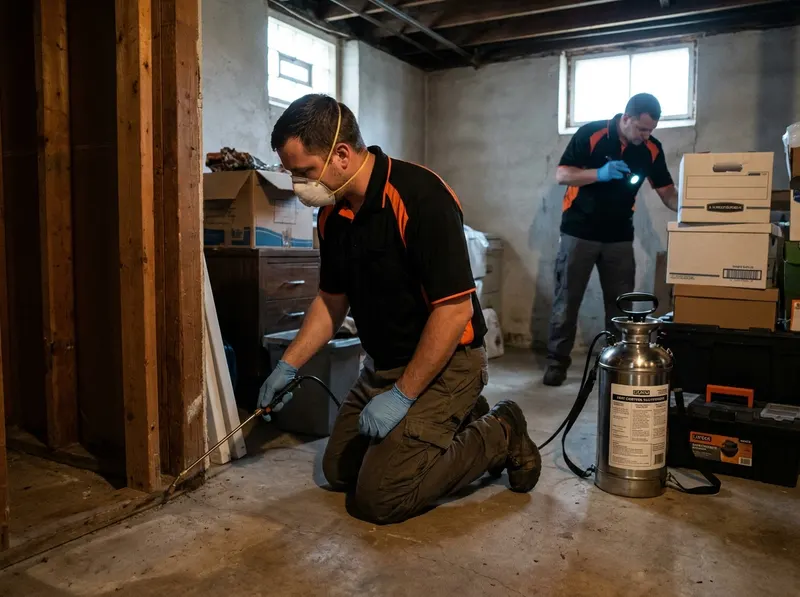
A targeted physical and environmental health protocol isolates the infestation without broad-spectrum chemical saturation across upper residential floors. Decisive intervention combines an insect growth regulator (pyriproxyfen) with an adult knockdown agent applied exclusively to structural perimeters, mortar joints, furnace utility perimeters, and sub-floor joists. While a light topical vacuuming extracts surface-level adults, juvenile larvae burrow up to 2 inches deep into dusty concrete joints and timber margins. Disrupting the biological molt cycle neutralizes emerging instars before they ascend into upper living spaces in Shadyside or Bloomfield homes.

Property layout guides the execution strategy. If a basement features raw fieldstone, open floor drains, and bare earth floor sections, common throughout Mount Washington and Brookline properties, technicians establish a sealed residual barrier directly against the exterior band joist and interior foundation perimeter. If the basement is partially finished with drywall framing or raised subfloors, technicians switch to wall-void micro-injection to neutralize harborages without saturating finished carpets or drywall. Occupants and family pets vacate the basement perimeter during application, returning once mechanical ventilation dries the treated masonry surfaces in 2 to 4 hours.

Basement Flea and Tick Eradication cost in Pittsburgh

Unfinished Stone Foundation Basement (Up to 800 sq ft)$200, $275
Standard Partial-Finished Basement (800 to 1,500 sq ft)$275, $375
Full-Footprint Basement with Crawlspace Utility Voids$375, $475
Integrated Rodent Harborage Extraction & Perimeter Defense$450, $650

Every job gets a firm, written price after a free on-site visit.

Common questions

How does the damp Pittsburgh climate affect basement flea and tick survival?
Basements in Pittsburgh sustain natural ground dampness and river-valley humidity, which prevents flea pupae and deer ticks from desiccating. Flea larvae require at least 50% relative humidity to survive, a metric routinely exceeded in sub-grade foundations across Highland Park and East Liberty.
Are basement flea and tick eradication treatments safe for children and pets in Pittsburgh homes?
Applied treatments dry into a bound crystal matrix within 2 to 4 hours, anchoring the active insect growth regulator to the masonry substrate where it cannot transfer to animal paws or family footwear. Technicians require that pets and residents remain outside the lower mechanical boundary until the barrier completely dries.
Why is regular carpet cleaning insufficient for flea infestations in a Pittsburgh basement?
Steam cleaning or standard carpet vacuums do not penetrate the microscopic voids between rough concrete, sill plates, and mortar lines where over 80% of eggs and larvae settle. Clinical eradication pairs targeted adulticides with hormonal growth regulators that stop the biological maturation process inside structural joints.
Can ticks reproduce and establish colonies in a Pittsburgh basement without an outdoor host?
While blacklegged ticks prefer outdoor leaf litter, brown dog ticks (*Rhipicephalus sanguineus*) can complete their entire life cycle indoors, nesting inside foundation cracks, sill plates, and sub-floor voids of Allegheny County houses once introduced.
How many treatments are required to clear an active basement infestation in Pittsburgh?
A single targeted protocol using micro-encapsulated adulticides combined with a 7-month insect growth regulator controls the active adult population immediately while terminating dormant pupae as they hatch over a 14-day developmental cycle, avoiding repetitive full-house chemical treatments.
Helpful resources

Trusted references & local links

USA.gov, government & consumer helpBetter Business BureauFTC Consumer AdviceU.S. Small Business AdministrationReady.govU.S. EPAENERGY STARU.S. Dept. of EnergyConsumer.govU.S. Census BureauGoogle Maps, Pittsburgh, PA

Get started today

Tell us about your basement flea and tick eradication job in Pittsburgh and we'll send a clear, written quote, usually the same day.

Get your free pest control services quote, Pittsburgh

We only use your ZIP to check availability, no spam.